
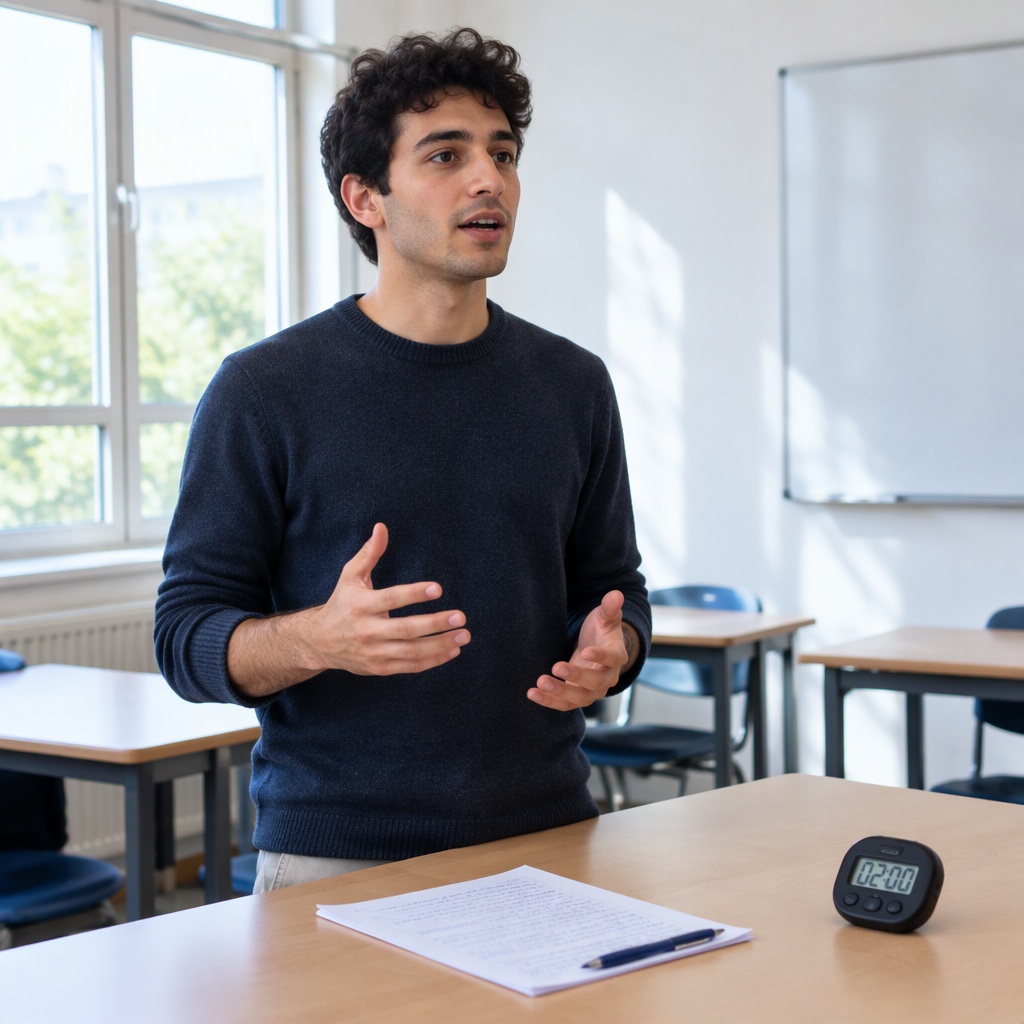
This package is designed to help you work on the DELF A2 Speaking test in conditions close to the real exam. It is suitable if you want to practice with a variety of topics, model answers, and practical tips, at your own pace.
Who this package is useful for
This course is intended for learners preparing for the DELF A2 who want to feel more confident speaking. It is also suitable for teachers and training centers looking for ready-to-use materials to train groups or students.
The target exam is the Speaking test. The format announced includes three parts: a guided interview, a continuous monologue, and an interaction task. If you are preparing for a French exam and need a clear framework, this type of mock test is a good fit.
The package is designed around everyday situations. You work on simple, useful tasks: introducing yourself, describing an experience, expressing your likes and dislikes, making suggestions, asking questions, and answering the examiner more naturally.
- For DELF A2 candidates
- For teachers and training centers
- To work on speaking in a structured way
What you will be able to do after the training
After this work, you will be better prepared for how the exam is organized. You will know the three parts of the speaking test and the kind of production expected in each one.
You will also have practiced model answers. This helps you understand how to start a response, how to develop it simply, and how to stay on topic.
The practical tips and detailed explanations are meant to improve the way you speak. You can therefore work on fluency, confidence, and the ability to interact in a short exchange.
The topics are presented as matching the official format of France Éducation International. So you are not only working on isolated sentences, but on situations close to what the exam requires.
- Understand the 3 parts of the speaking test
- Know how to answer more clearly
- Stay within a framework close to the exam
How to study week by week
Start by reading the exam format and the instructions for each part. Do not try to say everything at once. The goal is to build simple automatic habits.
In the first week, do a full mock test without stopping for too long. Identify what feels easy and what blocks you. For example, see whether you can introduce yourself without hesitation or whether you search for words.
In the second week, work on the model answers. Go back to a question, then practice answering it out loud. Use short sentences. Focus on clarity rather than length.
In the third week, focus on interaction. Practice asking a question, suggesting something, and reacting to an answer. This is useful for the interaction task, where you need to exchange ideas rather than just speak alone.
In the fourth week, do another mock test in conditions close to the exam. Keep to the preparation time stated in the package. Try to speak for the full allotted time without stopping to rephrase everything.
Then repeat the cycle. Use the pedagogical corrections to review the same weak points. If you are a teacher, you can turn each test into a short lesson: preparation, oral performance, feedback with corrections, then another attempt.
A few simple rules help a lot: speak aloud, record yourself if possible, reuse useful expressions, and repeat the topics that seem closest to everyday life.
- Read the format
- Do a first mock test
- Work on model answers
- Practice interaction
- Do a full test again
How to know if you are ready
You are more ready when you can move through the three parts without losing your way. You should know what to do in a guided interview, a continuous monologue, and a short interaction.
You are also ready when your answers are simple but complete. For example, you can introduce yourself, talk about an experience, give your personal opinion, ask a question, and respond clearly.
Another useful sign is your ease. If you can speak fairly fluently despite a few hesitations, and if you understand the instructions without help, you are on the right track.
Finally, look at your progress in the tests. If the pedagogical corrections help you find your bearings and you are correcting the same mistakes more and more often, your preparation is becoming stronger.
The best test is still a full topic completed under the stated conditions: 10 minutes of preparation, then 6 to 8 minutes of exam time. If you can handle that framework confidently, you know where you stand.
- Understand the 3 parts
- Answer clearly and simply
- Keep your speech fairly fluent
- Stick to the timing
Key points
- Work on A2 speaking with topics close to the official format.
- Use the model answers to build simple sentences.
- Go back over the corrections to fix your weak points.
- Practice the three parts of the exam.
- Redo full tests to check your level.
Questions and answers
Is this package suitable for someone who is just starting DELF A2 speaking?
Yes, if they want to work with guided topics and model answers. The announced format helps them understand what is expected in the exam without starting from scratch.
What exactly is covered in the DELF A2 Speaking test?
All three parts of the exam are covered: guided interview, continuous monologue, and interaction. You also work on everyday situations, such as introducing yourself, telling a story, and asking questions.
How should the mock tests be used effectively?
First, do a test to identify your difficulties, then go back to the models and practical tips. Doing the full topic again after correction helps you see what has changed in the way you speak.
Study this with us: DELF/DALF A2 - Production orale