
Right of way remains one of the trickiest parts of the Highway Code, not because the rule is mysterious, but because it changes with the context. Once you understand the logic, you answer exam questions better and read the road more quickly.
The logic of right of way: seeing who must go first
In the Highway Code, the correct answer does not always come from a single sign. You first have to identify who actually has priority at that moment. An intersection may seem simple, but a yield sign, priority to the right, road markings, or a traffic light can completely change the order of passage.
The useful method is always the same. First look at vertical signs, then horizontal signs, then the configuration of the vehicles. If a sign gives a clear rule, it overrides the general rule. If nothing is indicated, priority to the right applies again. This hierarchy avoids many mistakes in tests.
In practice, the most common mistake is reading just one piece of information too quickly. Many candidates see a main road and forget a small yield sign. Others spot a roundabout and automatically apply a rule without checking the entry signs. The reflex should be methodical, not instinctive.
- Visible sign first
- Then road markings
- Then the general rule if nothing says otherwise
The difficult case: when several clues seem to contradict each other
Difficult questions often rely on an apparent ambiguity. For example, you may see an intersection with a road that seems like the main road, but a sign requires you to give way. In that case, the sign decides. The widest road, the heaviest traffic, or the most natural direction are never enough on their own.
Another common case: priority vehicles. An ambulance or emergency vehicle using active signals demands immediate attention, but that does not remove every safety rule. You do not launch into a dangerous maneuver just because you are giving way to it. You slow down, pull over if possible, and avoid blocking the space.
You also need to distinguish priority from confidence. Having the right of way does not mean going without looking. In exams as in real driving, a correct answer is often expressed cautiously. You may have the right to go first and still need to wait if the situation is not safe.
- The sign outweighs the visual impression
- A priority user does not justify a dangerous maneuver
- Having priority does not remove the duty to be safe
A complete example to reason without making a mistake
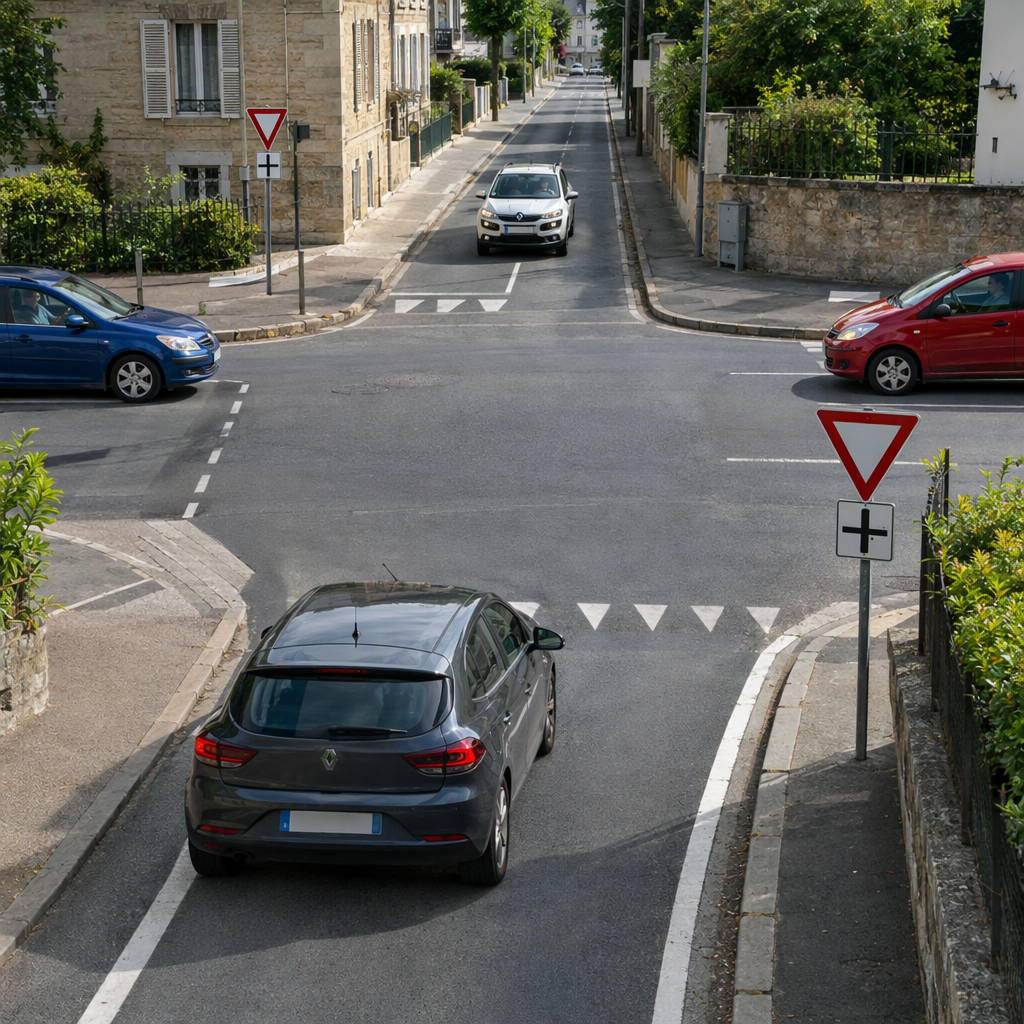
Imagine a four-way intersection. You arrive from the bottom of the image. On the right, a side street joins without any visible sign. Straight ahead, another vehicle is approaching too. On the left, a yield sign is placed on your lane. The correct reading is this: the sign requires you to give way. You cannot therefore use priority to the right to claim passage for yourself. The vehicle on your right, meanwhile, follows the normal rule if it has no sign to the contrary.
If, on the other hand, your lane had no sign and the others did, you would need to check who is actually subject to the obligation to yield. The candidate must learn to spot which driver is targeted by the sign, not just which sign appears in the image. That is often where the mistake slips in.
Take another example. You are in a roundabout with a priority-to-the-left sign, sometimes accompanied by clear markings. You are waiting at the entry. A vehicle is already circulating in the ring. It goes before you. Here the logic is simple: the vehicle already in the roundabout has priority. But if the sign were missing and the layout were unusual, you should not invent a rule. You would then return to a strict analysis of the situation.
This way of reasoning helps in mock exams. You have to read the scene like a technical document. Every detail matters. The right choice does not come from a general instinct, but from a chain of checks.
- Identify the driver affected by the sign
- Distinguish the entry lane from the lane already in use
- Do not replace the clues with a vague idea of a “main road”
The limits of the rule and what the exam is really testing
The Highway Code tests less raw memory than the ability to rank clues in order of importance. Traps appear when a rule is applied too quickly. Priority to the right is not a universal reflex. A yield sign is not just an invitation to slow down. A roundabout is not automatically priority-based if the signs are missing or the image shows something else.
There is also a practical limit: the exam image simplifies real roads. In real traffic, visibility, the speed of other vehicles, and the presence of several users make the decision more complicated. You may know the rule and still need to wait a few extra seconds to make the maneuver safe. The exam accepts that caution, as long as it remains consistent.
Finally, you have to accept that a question is designed to check your careful reading, not to describe an everyday situation. If you first look for the hierarchy of clues, you will have a stable method. If you first rely on driving habits, you risk making mistakes on details that are nevertheless decisive.
- The exam checks a reading method
- Caution remains compatible with priority
- Visual details can change the answer
Key points
- Look for the signs before relying on instinct
- Let the sign take priority over the general rule
- Identify who is actually affected by the right of way
- Do not confuse priority with moving forward without vigilance
Questions and answers
Does priority to the right always apply?
No. It applies only when no specific sign replaces it. As soon as a sign or marking imposes another rule, that indication takes precedence.
If I have priority, can I move forward without looking?
No. Having priority gives you the right of way, not the right to ignore danger. In driving as in the exam, you must always check that the maneuver is safe.
How can I avoid mistakes at intersections?
Use the same method every time: spot the signs, look at the road markings, then identify the vehicles involved. This ordered reading reduces confusion.
Study this with us: Code de la route français – Des tests gratuits